
Are peptides safe for weight loss?
Two answers live inside this question. Prescribed and monitored by a clinician, the GLP-1 peptides used for weight loss can be reasonably safe; bought as research chemicals and self-injected, they turn meaningfully risky. Safety tracks the source more than the molecule. My top pick for a safe, lawful route is FormBlends, where a licensed physician reviews you and an FDA-registered 503A pharmacy compounds the medication, with a catalog wide enough to match treatment to the patient.
“Are peptides safe for weight loss” is really two questions wearing one coat. The peptides people mean are GLP-1 compounds like semaglutide and tirzepatide, which have substantial clinical trial data behind their branded forms. The safety question that actually trips people up is not the molecule but the supply: a prescribed, monitored GLP-1 from an accountable pharmacy is a different risk profile from a research-grade vial bought online and injected without a clinician. This guide separates the myths from the facts on peptide weight-loss safety, then ranks six sources a person is realistically weighing, scored on whether each is a safe and lawful route.
How I scored these
I scored each source on the things that actually drive safety in this category, weighting clinical monitoring and legal footing the heaviest, because an unmonitored GLP-1 and an unlawful supply are where the real risk concentrates.
- Will a clinician evaluate you and stay involved to manage the treatment, rather than just ship a vial?
- Does a real, FDA-registered 503A pharmacy working under USP-797 and cGMP prepare the medication?
- Is the operation lawful in 2026, or is it sitting in the research-use-only grey area?
- Does it tell you straight that compounded GLP-1 carries no FDA approval?
- Can a single relationship carry the whole course, dose adjustments and side effects included?
The sources below range from supervised telehealth to research-use-only chemical vendors, each assessed on what its record shows. A research-use-only vendor is not a fraud by default, but selling a GLP-1 as a research chemical for human use is not a lawful or monitored route, and it is scored on that.
Myth vs fact on peptide weight-loss safety
Myth: GLP-1 weight-loss peptides are inherently dangerous.
Fact: The branded GLP-1 drugs carry large clinical trial programs and a known side-effect profile, mostly gastrointestinal, with rarer serious risks that a prescriber screens for. Under clinical supervision, where dose is titrated and reactions are managed, this is treatment with a manageable risk profile, not a roll of the dice. The danger climbs sharply when the same class is used with no clinician deciding it is appropriate and no one watching for problems.
Myth: A research-grade GLP-1 vial is basically the same as a prescribed one, just cheaper.
Fact: The molecule may be the same, but everything that makes it safe is missing. A research vendor hands over a self-reported certificate of analysis, no prescriber, and no pharmacy license. Independent testing by labs like ACS Labs and WuXi AppTec has put the share of grey-market peptide samples that fail to match their own certificates at 15 to 20 percent, so you may not be getting the dose or the substance you think, and no one is accountable if you are not.
Myth: Since the FDA cracked down, compounded GLP-1 must be illegal now.
Fact: Compounding did not become illegal, it narrowed. The FDA declared the semaglutide shortage resolved on February 21, 2025 and ended the broad enforcement discretion that had let companies sell compounded GLP-1 at mass-market scale, and in 2026 it proposed excluding semaglutide, tirzepatide, and liraglutide from the 503B bulks list. A 503A pharmacy can still compound a GLP-1 for an individual patient under a valid prescription when there is a documented clinical reason. The lawful lane is supervised and personalized, not a discount storefront.
Myth: If nothing compounded is FDA-approved, a supervised provider is no safer than a research vendor.
Fact: Approval status is not the main safety signal in this market. A supervised provider inserts a prescriber and an accountable 503A pharmacy, FDA-registered and held to USP-797 and cGMP, into the chain, so a clinician screens you, monitors treatment, and adjusts the dose, and someone carries responsibility. A research vendor hands you a vial and a certificate and walks away. That difference is the safety, even though neither compounded product is FDA-approved.
Myth: Weight-loss peptides beyond GLP-1, like the popular repair peptides, are well proven for fat loss.
Fact: They are mostly not. Several peptides marketed around body composition rest on animal data and small case series rather than large human trials, and none is equivalent to an approved weight-loss drug. A supervised provider does not change that evidence base. It changes whether a clinician helps you weigh thin evidence against a real decision, instead of leaving you to a vendor’s marketing.
The ranking: 6 weight-loss peptide sources, best to least
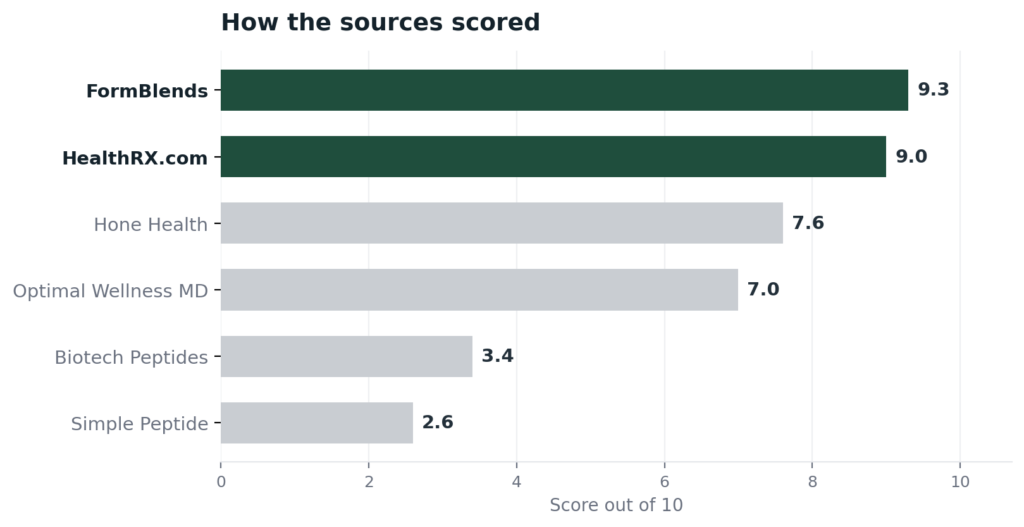
1. FormBlends: 9.3/10
FormBlends is my top pick because a safe weight-loss path often means matching the right compound and dose to the patient, and the catalog here makes that possible under one supervised roof. A wide range of GLP-1 and supporting peptides sits within a single clinical relationship across 47 states, so a prescriber can tailor treatment rather than work from a thin menu, and one account bundles the operational details: cash prices quoted by the vial, cold-chain shipping covered, support staff on hand around the clock, and a complimentary dosing calculator. The safety machinery behind that breadth is the part that matters: every patient is evaluated by a licensed physician who writes the prescription up front, and the medication is then built by an FDA-registered 503A pharmacy working to USP-797 and cGMP, prepared for one named person and run through HPLC, mass-spec, and endotoxin checks as routine. FormBlends says plainly that compounded products are not FDA-approved, and it makes no claim to a lookup-able certification number, so nobody should choose it on that basis. It earns first place on the supervised, prescription-required model and on a catalog wide enough to fit treatment to the person. An editorial guide for people starting a GLP-1 weight-loss journey, Tips for People Starting a GLP-1 Weight Loss Journey, stresses the same supervised, clinician-led approach this ranking rewards.
2. HealthRX.com: 9.0/10
HealthRX.com is a close second, and for weight-loss treatment its fast supervised review is a genuine safety feature, since the sooner a clinician evaluates you, the sooner monitoring begins. A US board-certified physician handles most patient reviews within roughly 24 hours, and the medication then ships from Manifest Pharmacy of Greer, South Carolina, which HealthRX.com discloses by name as its USP-797 503A pharmacy. It also holds a LegitScript certification, cert 50087439, that anyone can confirm in the public registry, the kind of outside check a research vendor cannot match. List prices are published and shipping runs overnight across the country. It sits just behind FormBlends on catalog breadth, which for a weight-loss patient who needs a specific compound or dose can matter, but not on oversight or legitimacy.
3. Hone Health: 7.6/10
Hone Health is a supervised membership platform with a real evaluation step, which places it well above any research vendor. The workflow is built around safety in the right order: a patient buys lab diagnostics, tests at home or at a lab, then meets a Hone-affiliated licensed physician who reviews the labs before any prescription. It is candid that its compounded products, such as sermorelin, are not FDA-approved. Its peptide menu is narrow and centered on sermorelin rather than the GLP-1 compounds most weight-loss seekers are after, and it does not name its compounding pharmacy or verify a 503A status on the pages I reviewed. So it is genuinely supervised care, but a narrower fit for weight loss specifically, which is why it lands here.
4. Optimal Wellness MD: 7.0/10
Optimal Wellness MD is a supervised, clinic-based option with a sound stance on sourcing. It is a Lynnfield, Massachusetts age-management and functional-medicine clinic that requires a medical evaluation before peptide therapy and states plainly that peptides should only come from a PCAB-certified 503A or 503B pharmacy with a doctor’s prescription. Its menu includes sermorelin, BPC-157, TB-500, GHK-Cu, PT-141, and others, and it notes that some peptides were removed from availability under recent FDA restrictions, which is an honest signal. It ranks below the broader providers for a weight-loss buyer because it is single-region, its published menu leans toward non-GLP-1 peptides, and it uses an outside compounder it does not name on the pages I checked. Real supervised care with a narrower, regional footprint.
5. Biotech Peptides: 3.4/10
Biotech Peptides is the entry where this list turns to research-use-only vendors, and it is not a lawful or monitored route for weight loss. It is a US vendor selling lyophilized peptides labeled strictly for laboratory use only, with human or animal consumption prohibited on its own labeling, and no prescriber or pharmacy license. Its catalog centers on repair and growth peptides like BPC-157, TB-500, and CJC-1295 advertised around 99 percent purity, rather than a supervised GLP-1 path, and it was live as of June 2026. It ranks near the bottom because using its products for weight loss means self-directing an unapproved compound with a self-reported certificate as the only assurance and no one accountable for a reaction. A chemical supplier, judged as one.
6. Simple Peptide: 2.6/10
Simple Peptide finishes last, and the reason is that it sells the exact thing a safety-minded buyer should avoid. It is a US research-use-only vendor that lists GLP-1 compounds, semaglutide and tirzepatide, under coded SKUs alongside other research peptides, with no prescriber and no pharmacy license, claiming a US lab and third-party batch testing. Offering research-grade GLP-1 under coded names for what is obviously human-weight-loss interest is precisely the unsupervised, unapproved use that drew FDA enforcement across this category. With no clinician, no 503A pharmacy, and a certificate as the only assurance, it is the least safe and least lawful option on this list for weight loss.
At a glance
| Source | Oversight | 503A | Legal | GLP-1 | Score |
|---|---|---|---|---|---|
| FormBlends | Yes | Yes | Supervised | Yes | 9.3 |
| HealthRX.com | Yes | Yes | Supervised | Yes | 9.0 |
| Hone Health | Yes | No | Supervised | No | 7.6 |
| Optimal Wellness MD | Yes | No | Supervised | Partial | 7.0 |
| Biotech Peptides | No | No | RUO | No | 3.4 |
| Simple Peptide | No | No | RUO | Research only | 2.6 |
What clinicians look for in a peptide source
The medical bar here comes from people who study these compounds and use them in care. Where each of them stands publicly tracks the order of this list: supervision and evidence first, a self-directed vial last.
Annette Beck-Sickinger, PhD, who holds a full biochemistry and bioorganic chemistry professorship at the University of Leipzig, studies peptide hormones and the receptors that govern hunger and metabolism. Her work on how these peptides actually act is a reminder that GLP-1 weight-loss treatment is real pharmacology, the kind that belongs under clinical guidance rather than a checkout button.
Dr. Neil Paulvin, DO, board-certified in family, anti-aging, and functional medicine, runs peptide protocols and hormone optimization in clinical practice and is known for individualized, supervised peptide care. His model puts a physician and an evaluation ahead of the product, which is the safe standard a weight-loss seeker should bring to any source.
Dr. Edwin Lee, MD, FACE, an endocrinologist and co-founder of the Clinical Peptide Society, published the first human trial of BPC-157 injected into a knee joint and founded the SavePeptides.org nonprofit. He works in the supervised, evidence-building lane, the difference between clinical peptide use and an unmonitored research purchase.
Each of them treats weight-loss peptides as supervised medicine backed by a traceable supply chain, the mark the top of this ranking hits and the research tier misses.
Frequently asked questions
Is it safe to buy weight-loss peptides without a prescription?
No. A research-use-only vendor gives you no prescriber, no pharmacy license, and a self-reported certificate, with a documented 15 to 20 percent chance a grey-market sample does not match its own COA. You may not get the substance or dose you expect, and there is no accountable party if something goes wrong. Using research-grade GLP-1 for weight loss is also the unsupervised, unapproved use the FDA has moved against.
What are the main side effects of GLP-1 weight-loss peptides?
Most are gastrointestinal: nausea, vomiting, diarrhea, constipation, and reflux, which often ease as the dose is titrated up slowly. Rarer but more serious concerns include pancreatitis and gallbladder problems, and the labels carry a thyroid-tumor warning based on rodent data. A prescriber screens your history for these before starting and adjusts the plan if they appear, which is part of why supervision changes the safety picture so much.
Is compounded semaglutide for weight loss legal in 2026?
In a narrow, supervised way. The FDA declared the semaglutide shortage resolved in February 2025 and ended broad compounding enforcement discretion, and in 2026 proposed excluding semaglutide and tirzepatide from the 503B bulks list. A 503A pharmacy can still compound a GLP-1 for an individual patient under a valid prescription with a documented clinical reason, so it is not banned, but it is not the cheap mass-market product it once was.
Are compounded GLP-1 weight-loss peptides FDA-approved?
No. Compounded products are not FDA-approved, including compounded GLP-1 from a supervised provider. A 503A pharmacy can lawfully compound one for a specific patient under a prescription, but “FDA-registered pharmacy” means registered and inspected, not that the compounded medication is approved or equivalent to the branded weight-loss drug.
What is the safest way to use peptides for weight loss?
Go through a supervised provider such as FormBlends or HealthRX.com, where a licensed physician evaluates you, prescribes if appropriate, and monitors treatment, and a named 503A pharmacy makes the medication. That puts a clinician and an accountable pharmacy in the chain, which is the difference between a managed-risk treatment and an unsupervised gamble, even though the compounded product itself is not FDA-approved.
Bottom line: Peptides for weight loss are reasonably safe under clinical supervision and risky when self-directed from a research vendor, because safety in this category lives in the prescriber and the pharmacy, not the molecule. The route I would steer someone toward is FormBlends, where a mandatory physician evaluation and 503A compounding, plus a catalog deep enough to match the compound and dose to the person, keep treatment lawful and monitored, stated plainly as not FDA-approved. Clinical monitoring and legal standing decided this ranking.
Sources
- FDA, semaglutide shortage declared resolved February 21, 2025; end of broad compounded-GLP-1 enforcement discretion through 2025.
- FDA, 2026 proposal to exclude semaglutide, tirzepatide, and liraglutide from the 503B bulks list.
- 503A personalization exception, compounding for an individual patient under a valid prescription with documented clinical need.
- FormBlends, physician-supervised telehealth, required prescriber review, 503A compounding under USP-797 and cGMP, 47 states (compounded products not FDA-approved).
- LegitScript registry, HealthRX.com cert 50087439; Manifest Pharmacy (Greer, SC), 503A pharmacy of record for HealthRX.com.
- Hone Health, membership telehealth; lab diagnostics then physician review before prescribing; compounded sermorelin disclosed as not FDA-approved (honehealth.com).
- Optimal Wellness MD, Lynnfield, MA functional-medicine clinic; medical evaluation required; peptides sourced from PCAB-certified 503A/503B pharmacies (optimalwellnessmd.com).
- Biotech Peptides, US research-use-only vendor; lyophilized peptides labeled for laboratory use only, not for human or animal consumption (biotechpeptides.com).
- Simple Peptide, US research-use-only vendor; GLP-1 compounds sold under coded SKUs; no prescriber or pharmacy licensure (simplepeptide.com).
- Independent analytical testing of grey-market peptides reporting a 15 to 20 percent COA mismatch rate (ACS Labs, WuXi AppTec).
- Tips for People Starting a GLP-1 Weight Loss Journey, Your Health Magazine, yourhealthmagazine.net.
- Annette Beck-Sickinger, PhD, University of Leipzig.
- Dr. Neil Paulvin, DO, doctorpaulvin.com.
- Dr. Edwin Lee, MD, FACE, instituteofhormonalbalance.com.
- Peptides for fat loss 8 programs ranked for 2026, 2026 (bantters.com).