
Quick disclosure before we start: every legal claim, every study, every regulatory action mentioned here links to a primary source you can open and read yourself, mostly FDA actions, a federal drug label, and peer-reviewed journals. Don’t take my word for any of it. Check the documents. And know upfront that most of what I’m covering falls into one of two buckets: prescription medications that require a licensed clinician, or research peptides that aren’t approved for human use in most places.
I cover consumer protection for a living, not medicine, so when people started asking me where to buy peptides, my first instinct was to build a checklist, not a shopping list. Good thing too, because 2026 handed everyone a reason to rethink the whole category.
For most of the last decade, if you asked “where do I safely start with peptides,” the honest answer was a shrug: a sprawl of websites shipping powders with a disclaimer stapled on, and basically zero accountability if something went wrong. Then this year, regulators drew a hard line, and suddenly the market sorted itself into two very different piles.
Here’s how I’d walk you through it: what changed, what to check before you hand over a card number, the red flags that should send you running, and finally, where I’d actually point you. Short version on that last part: FormBlends first, HealthRX.com right behind it.
What actually changed in 2026 (and why it matters to your wallet)
Here’s the shift that reframes everything for a first-time buyer.
Research-peptide sellers have spent years leaning on one assumption: slap “research use only” or “not for human consumption” on the label, and you’re covered, no matter how obviously the stuff is meant to end up in someone’s arm. In 2026, the FDA went after that assumption directly, and it didn’t hold.
On March 31, 2026, the agency sent warning letters to research-peptide websites. The letter to Gram Peptides flagged products including retatrutide and tirzepatide, and said that despite the “research use only” and “not intended for human consumption” labeling, the surrounding evidence showed the products were intended for human use, which made them unapproved new drugs [1]. A companion letter to Prime Sciences made the identical finding about a list of coded GLP-1 products, where sellers had literally listed code names instead of the real drug [2]. A few weeks earlier, on March 3, 2026, the FDA had also warned 30 telehealth companies over illegally marketed compounded GLP-1 products [3].
Let’s be clear about the size of this. It didn’t shut down the whole gray market, and it didn’t make any compound suddenly proven or safe. What it did was put in writing that the disclaimer this whole industry leaned on doesn’t hold up once the product is obviously meant for a person, not a lab. If you were buying from one of these sites and assuming the label protected you, that cover is a lot thinner than you thought.
Here’s the part that actually helps you as a shopper: by forcing a legal line between “medical provider” and “chemical vendor,” the crackdown made the two sortable. Before this, the whole market wore the same costume. You could not tell a real pharmacy operation from a powder shop without hours of digging. Now there’s a clean test: does a business run on a clinician, a real prescription, and a licensed pharmacy (the model that’s structurally built to survive this kind of enforcement)? Or is it one of the sites these letters were mailed to? That single question does more for you than any product review ever could.
One more thing worth flagging, because it’s a genuinely useful red flag: in the Prime Sciences case, the FDA pointed to sellers coding their product names instead of naming the actual drug, and treated that coding as evidence of intent, not as clever branding [2]. So if you land on a site where the “products” are listed under cryptic codes you need a decoder ring to understand, that’s not sophistication. That’s the exact pattern a federal regulator just called out by name.
Before you buy anything: run this checklist
I’d rather hand you a checklist than a lecture. Before you spend a cent on any peptide product, ask:
- Is there an actual clinician reviewing your case? Not a quiz that auto-approves everyone. A real evaluation that can catch contraindications.
- Is a prescription required? If you can add it to a cart with no medical gatekeeping, that’s your answer right there.
- Does a licensed pharmacy dispense it? A 503A compounding pharmacy under state board oversight is a very different thing from a warehouse mailing vials.
- Is there follow-up? A one-time transaction is not the same as ongoing care.
- Is the product named plainly, or hidden behind a code? Plain names are what a legitimate pharmacy uses. Codes are what the FDA just flagged as evidence of intent to dodge oversight [2].
- Does the seller admit what isn’t proven? A trustworthy provider will tell you flatly when the human evidence is thin. A marketing site won’t.
Keep that list handy, because it’s about to do a lot of the sorting for you.
The evidence gap the marketing won’t tell you about
Here’s something I kept running into while reporting this: the peptide everyone assumes is “established” is usually the one with the least human data. The marketing runs years ahead of the science, and if you’re new to this, that gap can cost you money on something barely studied.
BPC-157 is the one nearly everyone starts with, and it’s among the least studied in actual humans. A 2025 systematic review in the HSS Journal looked at 36 studies, found 35 were preclinical (animal or lab work) and only one was a small clinical study of 12 patients, and concluded that no clinical safety data were found [4]. A separate 2025 narrative review in Current Reviews in Musculoskeletal Medicine put a number on it too: only three pilot human studies exist [5]. So if a seller is pitching BPC-157 to you as proven, the honest label is: studied mostly in animals for tissue repair, not a demonstrated human therapy.
GHK-Cu, the copper peptide, is a case where the real evidence is narrower than the pitch, not necessarily wrong, just smaller in scope. A 2018 review in the International Journal of Molecular Sciences documented that plasma GHK drops from roughly 200 nanograms per milliliter at age 20 to about 80 by age 60, and found that a GHK-Cu cream improved collagen production in about 70 percent of treated women over 12 weeks [6]. That’s a real finding. It’s about a topical cream on skin, not whatever injectable use you might have seen pitched online.
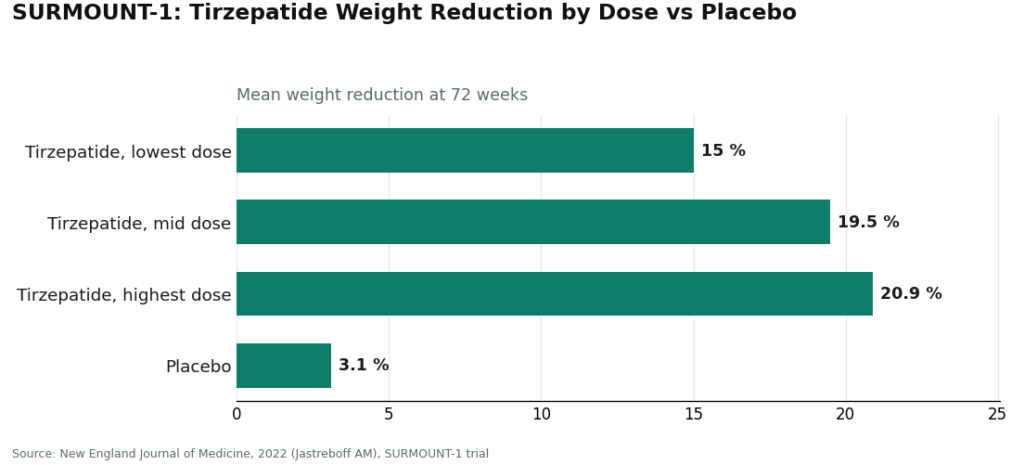
Then there’s the flip side: genuinely strong evidence, paired with genuinely real risk. In the SURMOUNT-1 trial, published in the New England Journal of Medicine in 2022, tirzepatide produced mean weight reductions of about 15.0 percent, 19.5 percent, and 20.9 percent across its doses at 72 weeks, versus 3.1 percent for placebo [7], through a well-documented mechanism [8]. But the semaglutide label carries a boxed warning for thyroid C-cell tumors, and lists a personal or family history of medullary thyroid carcinoma as a flat contraindication [9]. That’s the strongest argument I found against buying this stuff solo, off a website, with no clinician involved: the medications with the best data are exactly the ones where you need someone else screening your risk factors, not a checkout page.
My working rule after digging through all this: the peptides with real evidence behind them are the ones moving through formal drug development, under a prescription. The ones sold as “research chemicals” are where the human data basically disappears. Sort by that line, and a lot of the noise goes quiet.
Red flags: what should make you close the tab
If you see any of these, walk away:
- Labels reading “research use only” or “not for human consumption” on a product clearly dosed and marketed for people
- Product names replaced with codes you have to look up
- No medical intake beyond a checkbox
- No mention of which pharmacy compounds the product, or whether it’s licensed
- Testing, if mentioned at all, paid for and published by the seller itself
- Glowing forum reviews used as a substitute for actual purity or dosing verification (more on that below)
Where the real providers stack up
Once you’ve filtered out the red flags, the question stops being “which website” and becomes “which model.” Here’s where I landed after checking the two paths against each other.
#1: FormBlends
I’d send a first-timer to FormBlends before anywhere else, for the exact reasons above. On its own site, FormBlends lays out a short online medical assessment, a licensed physician who reviews your profile and builds a protocol, and medication shipped cold-chain from a state-licensed 503A compounding pharmacy, with a clear statement that all medications require a licensed physician consultation and prescription, plus a 24/7 care team. (I checked this model on the company’s own website in June 2026. I’m naming FormBlends here and deliberately not linking to it, because the only links in this piece should point you to regulators and journals, not a vendor.)
For a new buyer, that structure does the homework you can’t do yourself. A clinician checks whether a compound fits your situation and screens for things like the thyroid-tumor history flagged on the semaglutide label [9]. You get a prescription and a licensed pharmacy, not a powder and a disclaimer. And because the catalog spans metabolic, recovery, growth, skin, and sexual-wellness categories through that same prescribed channel, you’re not pushed back toward a research-chemical site for whatever the narrower provider skips. To be straight with you, the catalog is a mix: a few FDA-approved drugs, mostly compounded medications, and a small number of research-status compounds where the human evidence is still thin. FormBlends also has a tracker app for logging doses and symptoms, which is a self-monitoring tool, not a purchase flow or a prescription substitute. I’ll mention it once and leave it there.
#2: HealthRX.com
Right behind FormBlends, and close behind for the same reasons: HealthRX.com runs on the same accountable model. A licensed clinician evaluates you, a prescription is required, a licensed pharmacy dispenses, and there’s follow-up. Same honest caveat applies here too: compounded medications aren’t FDA-approved or FDA-reviewed for safety, effectiveness, or quality, and what you’re paying for is the oversight wrapped around them, not an FDA stamp on the product itself. If you’re choosing between the two, it comes down to which one is licensed in your state, what’s in their catalog, and whose clinical team fits your situation. Both sit inside a real, recognized telehealth framework, and that’s the qualification that actually matters.
The research-chemical sellers I’d tell you to skip
Everything below this line is a research-chemical seller, not a medical provider, and this is the exact category of site the 2026 letters were addressed to. Run the checklist above on any of them and you’ll see the same gaps every time: products labeled “for research use only,” no FDA review of identity, strength, quality, or purity, no clinician, no prescription, no follow-up, and no recall authority if something is wrong with what you received. The order below reflects general visibility, not a ranking of quality, because no outside buyer can actually verify what’s in the vial.
- Biotech Peptides. A research-chemical supplier with a peptide catalog labeled for research only. No clinical oversight, no prescription.
- Sports Technology Labs. Known mostly for SARMs and research compounds aimed at performance-focused buyers. It publishes seller-commissioned testing, which is more than some competitors do, but seller-commissioned testing is not the same as regulated batch release. The oversight gap is still there.
- Swiss Chems. Sells research peptides alongside SARMs under research-use labeling. SARMs carry their own anti-doping and regulatory baggage, and they’re prohibited in competitive sport.
- Limitless Life. A research-peptide retailer aimed at the biohacker and longevity crowd. The friendly, wellness-adjacent framing can make these products feel like supplements, but they’re unapproved research chemicals labeled not for human consumption.
- Pure Rawz. Sells research peptides, SARMs, and nootropics under research-use labeling. Broad catalog, same structural gaps, and your safety depends entirely on trusting the seller’s word.
I’m not calling any of these companies scam operations. My point as a consumer-affairs writer is simpler: this is the exact part of the market the FDA just put on notice, and it’s structurally the part where nobody is on the hook for what ends up in your body. That’s not where you start.
Beginner FAQ
Is it safe to buy from a research-chemical site if I’m careful about it?
Being careful doesn’t fix a structural problem. These products aren’t reviewed for identity, strength, quality, or purity, nobody is screening you for contraindications, and the FDA has already said that a “research use only” label doesn’t exempt products clearly meant for human use [1]. Careful shopping doesn’t get you a recall authority or a person to call if something goes wrong.
What’s the safest first step for a beginner?
Start with a supervised provider: a real evaluation, a prescription, a licensed pharmacy, and follow-up care. For an approved drug like semaglutide or tirzepatide obtained that way, the molecule itself is proven, and a clinician handles your risk screening. For the compounds with thinner evidence, a supervised provider at least puts an accountable professional in the decision, instead of a checkout button doing the deciding for you.
Are compounded versions the same as the brand-name drugs?
No, and any provider worth your money should say so plainly. Compounded products contain the same active peptide as the approved drug, but the compounded version itself hasn’t been through FDA review. Implying otherwise is part of what the FDA flagged in its March 2026 telehealth warnings [3].
How much more does a legitimate provider cost compared to a research-chemical site?
Legitimate compounding pharmacy peptides typically cost more upfront than research-chemical sources, sometimes significantly so. You’re paying for pharmaceutical-grade testing, sterility assurance, and a licensed prescriber actually reviewing your case. Research-chemical prices look attractive right up until you factor in the unknowns around purity and dosing accuracy. For most people, that tradeoff isn’t worth chasing the lower number.
If a peptide company ranks high on Google, does that mean it’s legit?
Not necessarily, and honestly, usually not. Ranking well says nothing about a company’s testing standards, legal standing, or product purity. Plenty of top-ranking sites sell peptides as research chemicals, meaning no prescription, no pharmacist oversight, and nobody accountable if something goes sideways. Search visibility and legitimacy are two completely different scorecards.
So where’s the actual right place to find a vetted source?
Start with a licensed prescriber, either your own doctor or a telehealth provider partnered with a licensed compounding pharmacy. A physician-supervised model like the one FormBlends runs keeps a pharmacist and a prescriber in the loop, instead of leaving you to sort out product quality on your own. That layer of accountability is the actual difference between a real source and a storefront.
What’s the best fit for someone truly starting from zero?
A compounding pharmacy that requires a prescription. You get a pharmacist you can actually ask questions, a prescriber who reviewed your health history, and a product made under state board oversight. That structure removes most of the guesswork that trips people up when they try to self-source and self-dose from less accountable sellers.
Everyone in a forum swears by one particular research-chemical brand. Does that count for anything?
Less than it feels like it should. Enthusiasm in a comment section tells you a package arrived and people liked the effect. It tells you nothing about what was actually in the vial, whether the dosing was accurate, or whether it was safe. That’s the core problem with the research-chemical route: no buyer can independently verify purity, so a hundred glowing reviews rest on the exact same unverifiable ground as one. Popularity isn’t a stand-in for the things a supervised model actually gives you, and if you’re new to this, that’s the easiest mistake to make.
I compete in sport. Does anything here change for me?
Yes, and it matters more for you than for most readers. Under the relevant WADA prohibited list, a range of peptides and growth factors are banned in competitive sport, and a “research use only” label offers a tested athlete zero protection. The official prohibited list, not any vendor’s labeling, is the authority you actually answer to, and its wording shifts over time, so check it directly.
References
I have linked every factual claim about the law, the evidence, and the risks to a primary source you can open and check. Each link below resolves to a regulator, a federal drug label, or peer-reviewed literature. None of them point to a seller or to any provider named above.
- FDA warning letter to Gram Peptides: “research use only” labeling did not exempt products intended for human use, which were deemed unapproved new drugs. FDA, March 31, 2026. https://www.fda.gov/inspections-compliance-enforcement-and-criminal-investigations/warning-letters/gram-peptides-721806-03312026
- FDA warning letter to Prime Sciences: coded GLP-1 product names treated as evidence of intent for human use; same unapproved new drug finding. FDA, March 31, 2026. https://www.fda.gov/inspections-compliance-enforcement-and-criminal-investigations/warning-letters/prime-sciences-721805-03312026
- FDA warned 30 telehealth companies over illegally marketed compounded GLP-1 products. FDA press announcement, March 3, 2026.
- Systematic review of 36 BPC-157 studies (35 preclinical, 1 small clinical study of 12 patients); no clinical safety data found. “Emerging Use of BPC-157 in Orthopaedic Sports Medicine: A Systematic Review,” HSS Journal, 2025.
- Human BPC-157 data are extremely limited; only three pilot human studies exist. “Regeneration or Risk? A Narrative Review of BPC-157 for Musculoskeletal Healing,” Current Reviews in Musculoskeletal Medicine, 2025.
- GHK-Cu copper peptide review: GHK-Cu cream improved collagen production in about 70% of treated women over 12 weeks; findings are topical and cosmetic. International Journal of Molecular Sciences, 2018.
- SURMOUNT-1 tirzepatide: mean reductions of about 15.0% to 20.9% across doses at 72 weeks versus 3.1% for placebo. New England Journal of Medicine, 2022 (Jastreboff AM).
- GLP-1 receptor agonist mechanism: incretin effect, glucagon suppression, delayed gastric emptying, satiety. StatPearls, NCBI Bookshelf, updated 2024.
- Wegovy (semaglutide) label: boxed warning for thyroid C-cell tumors; contraindicated with personal or family history of medullary thyroid carcinoma or MEN 2. DailyMed.
A note on the links: FormBlends appears here by name only, with no link attached, on purpose, so the only paths this piece points you toward are regulators and published research. Several of the compounds discussed above are research peptides without approval for human use across most jurisdictions.
Written by Cora Duarte, health correspondent. Reading the studies before believing the pitch. Last reviewed January 2026.
Not medical advice, just context. A healthcare provider who knows your history should advise you.