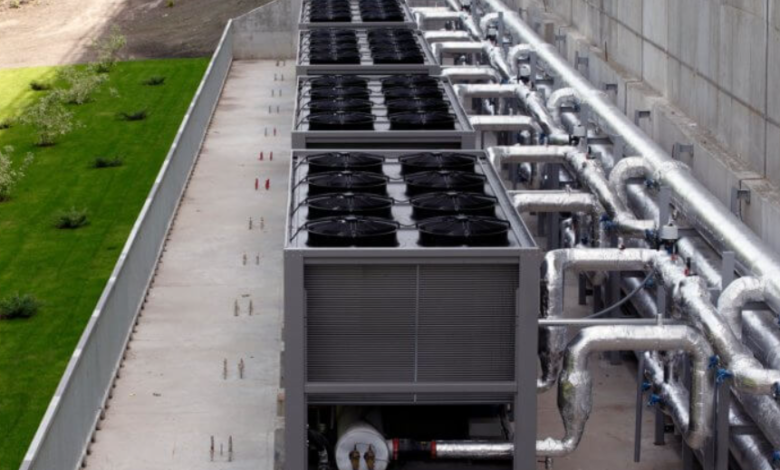
In today’s digital era, data centers have become the backbone of almost every industry, from finance to healthcare. As these facilities continue to expand, managing the immense heat generated by servers has become a critical challenge. Traditional air conditioning systems consume significant energy, increasing operational costs and environmental impact. This is where indirect evaporative cooling data center emerges as an innovative and sustainable solution for data centers.
What is Indirect Evaporative Cooling?
Indirect evaporative cooling is a method of cooling air without adding moisture directly to the space being cooled. Unlike direct evaporative cooling, where water is directly evaporated into the air, IEC uses a heat exchanger to transfer heat from the data center’s internal air to the evaporatively cooled air stream outside. This process reduces the temperature of the supply air without increasing humidity, making it ideal for sensitive IT equipment that requires precise environmental control.
How It Works
- Air Intake: Warm air from the data center is drawn into the system.
- Heat Exchange: The warm air passes through a heat exchanger where it transfers heat to an air stream cooled through water evaporation.
- Cooled Supply Air: The cooled air, now at an optimal temperature and low humidity, is delivered back into the data center.
- Exhaust: The warmed evaporative air is exhausted outside, preventing recirculation of heat and maintaining energy efficiency.
By separating the cooling and humidification processes, indirect evaporative cooling maintains ideal operating conditions for servers while significantly reducing energy consumption compared to conventional air conditioning.
See also: Unlock the Best Android Apps and Games with Our Expert Insights
Advantages of Indirect Evaporative Cooling in Data Centers
1. Energy Efficiency
IEC systems can reduce cooling energy consumption by up to 50% compared to traditional mechanical chillers. By leveraging natural evaporative processes, the system minimizes reliance on electricity-hungry compressors.
2. Environmental Sustainability
Since IEC relies on water evaporation rather than refrigerants, it reduces the carbon footprint of a data center. Modern systems are designed to use minimal water while maximizing cooling potential, contributing to sustainable building operations.
3. Enhanced Equipment Lifespan
Maintaining stable temperatures and low humidity reduces thermal stress and corrosion on servers and networking equipment, ultimately extending their operational life.
4. Cost Savings
Lower energy usage directly translates into reduced operational costs. Additionally, IEC systems have fewer moving parts than traditional HVAC units, leading to lower maintenance expenses.
5. Scalability
IEC solutions can be implemented in both small-scale server rooms and large hyperscale data centers. Modular designs allow operators to expand cooling capacity as the facility grows.
Design Considerations for Data Centers
Implementing an indirect evaporative cooling system requires careful planning to maximize efficiency and reliability.
- Climate Compatibility: IEC performs best in dry and moderate climates. In humid environments, pre-cooling or hybrid solutions may be necessary.
- Airflow Management: Proper design of air ducts and containment systems ensures uniform cooling and prevents hotspots.
- Water Quality: Using clean water and corrosion-resistant materials reduces maintenance requirements and prevents scaling or microbial growth.
- Redundancy: For mission-critical facilities, integrating backup cooling systems ensures continuous operation even during peak loads or maintenance.
Challenges and Mitigation Strategies
While IEC offers numerous benefits, some challenges must be addressed:
- High Humidity Regions: In areas with high ambient humidity, cooling effectiveness may drop. Combining IEC with traditional chillers or adiabatic pre-cooling can solve this issue.
- Water Availability: Continuous operation depends on a consistent water supply. Installing water-efficient systems and recirculation loops mitigates water scarcity concerns.
- Initial Investment: IEC systems may have higher upfront costs, but the long-term energy savings and reduced maintenance often offset this over time.
Applications of Indirect Evaporative Cooling
Beyond data centers, IEC technology is applicable in various sectors:
- Telecommunication Facilities: Ensures reliable operation of network hubs and switching centers.
- Industrial Manufacturing: Provides precise temperature control for sensitive processes.
- Commercial Buildings: Offers eco-friendly cooling for offices and retail spaces.
However, its most transformative impact is in data centers, where cooling efficiency directly correlates with operational cost and sustainability metrics.
FAQs About Indirect Evaporative Cooling Data Centers
Q1: Is indirect evaporative cooling suitable for all types of data centers?
A1: IEC is ideal for facilities in dry and moderate climates. For highly humid regions, hybrid solutions combining IEC with traditional cooling may be necessary.
Q2: How much energy can a data center save using IEC?
A2: Depending on the design and climate, IEC can reduce energy consumption for cooling by 40-60% compared to conventional HVAC systems.
Q3: Does IEC affect server humidity levels?
A3: No. Unlike direct evaporative cooling, IEC cools air without adding moisture, maintaining safe humidity levels for sensitive IT equipment.
Q4: What maintenance is required for IEC systems?
A4: Regular cleaning of heat exchangers, inspection of water quality, and monitoring airflow are typically sufficient. These systems generally require less maintenance than traditional chillers.
Q5: Can IEC handle high-density server racks?
A5: Yes. Properly designed IEC systems with effective airflow management can efficiently cool high-density racks and prevent hotspots.
Conclusion
Indirect evaporative cooling represents a transformative approach to data center temperature management. By separating cooling from humidification, IEC systems provide energy-efficient, sustainable, and reliable cooling for modern IT infrastructures. While upfront planning and climate considerations are essential, the long-term benefits in cost savings, environmental impact, and equipment longevity make IEC a compelling solution for data center operators. As the demand for data storage and processing grows, adopting innovative cooling strategies like IEC is not just advantageous—it’s becoming essential for sustainable operations.